.gif)
.jpg)
THIS is going to be sweet. Soon, very soon, those unappreciative little rotters who 15 years ago were expressing contempt for the television shows that were so important to their parents will be getting the same dissing from their own kids. That’s right, you 20-somethings; you’re about to be inducted into the Dinosaur Club.



 
Hey, Dad, Get With the (3-D) Program
Posted on: 09/14/10

A young generation expects to have 3-D TV because of movies like “Avatar.”
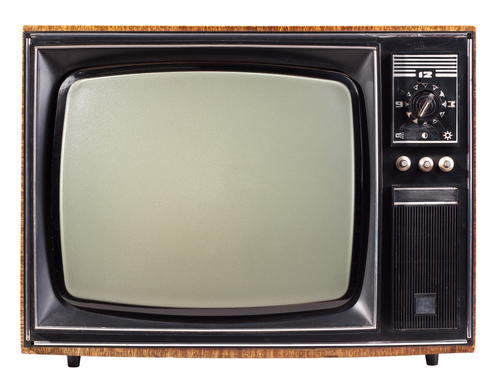
  Bettmann/CorbisAfter the first public showing of color TV in 1950.  CBS/PhotofestThe end of black-and-white shows like “The Munsters,” was inevitable. I know this because television technology is poised for another sea change, and when that happens, a curtain drops between generations, thick and impenetrable. Those growing up on one side of the curtain, the one represented by the new technology, cannot move backward into the previous technology any more than a person who discovers double-stuffed Oreos can ever go back to eating single-stuffed. I made this discovery back in the 1990s, when I owned a daughter in the most impressionable age range there is: older than toddler but not yet tween. It’s the age when you’re old enough to understand sophisticated plotlines and nuanced forms of humor like incongruity and sarcasm, even if your own repertory is still limited to “Goosebumps” books and knock-knock jokes. The age, in short, when a television show that tickles the emerging areas of your brain can leave a lasting impression. By the ’90s old TV series, the ones from my own impressionable years, were turning up regularly on cable channels like Nick at Nite. And so, hoping for a bonding experience, I would occasionally try to get my daughter to sit down and savor some of the classics with me. “There’s a ‘Twilight Zone’ marathon on,” I’d say. “I think you’ll enjoy the way Rod Serling laid a hint of the paranormal over the ordinary world to show that humanity lives its entire existence on the border between the mundane and the miraculous.” Or: “Hey, check this out: It’s a ‘Munsters’ episode. Let’s spend a pleasant half-hour admiring how Fred can simultaneously be the patriarchal figure, the butt of all jokes and the unsettling reminder that, however dormant, there’s a Frankenstein monster lurking in that midcentury stereotype of domestic bliss.” And each time I would attempt this intergenerational sharing, the kid’s response was the same: “Ack! Dad, I can’t watch that stuff; it’s in black and white.” And then she’d run screaming from the room as if I’d thrown acid in her eyes. A couple of times, if memory serves, she even called 911, or maybe it was Child Protective Services. It was, in short, the aforementioned curtain between two eras of television technology: me on the black-and-white side, my daughter and her generation on the color side. Today another curtain is getting ready to drop: the one between plain old color TV and 3-D television. It started in the movie theaters, of course, as did the switch from black and white to color; already you’re hearing little kids coming out of theaters complaining, “Why wasn’t it in 3-D?” And now it’s invading the living room. Which means that soon all you young new parents will have this to look forward to: PARENT: Look what I just found in the closet, my old boxed sets of “Buffy the Vampire Slayer” and “Boy Meets World.” Let’s watch a few episodes; I think you’ll enjoy the interplay between....” KID: Ack! Mom, I can’t watch those. They’re in 2-D. Where’s my cellphone? I gotta call Child Protective Services. Yes, perhaps some old shows can be converted to 3-D, just as some black-and-white shows were colorized. But that won’t bridge the generational divide; I have a colorized “Munsters” episode, and, well, one viewing was one too many. For one thing, those old shows, in the costuming, the shadings of the set, were made to be shot in black and white. For another — oh, never mind; if you need an explanation of why the Munster family in color is a travesty, you’re beyond redemption. I’ve talked to other parents who have also noted with dismay that their children, when young, refused to watch black-and-white shows. We’ve speculated on the cause of this phenomenon. For instance, for a while I thought it wasn’t really the black-and-whiteness so much as the pacing — the shows from my childhood didn’t have to compete for attention the way shows today do and thus were free to proceed at a leisurely pace that allowed them to take three minutes to build to a joke, rather than spray them around like machine-gun fire. Now, though, I’ve developed a whole different theory: I’ve come to believe that the compulsion to embrace any new television technology is genetic. The anticipation of the arrival of color television went on for an incredibly long time, beginning even before a marketable television system existed. Way back in 1928 — black-and-white films with sound had only barely begun to turn up in theaters — George Eastman demonstrated a primitive color home-movie camera, prompting a reporter for The New York Times, covering the unveiling, to get downright giddy about the future. “One must be a reactionary to the last degree to deny the possibility of a combination of action, sound and color, all reproduced in synchronization for entertainment in the home,” he wrote. “In other words, a picture of Babe Ruth or his successor, knocking out a home run, seen and heard at home through color television, pandemonium coming in by the ears and by the eyes a kaleidoscope of green sward, drab infield and many colored grandstand.” Twenty-one years later — still several years before the first color televisions were marketed, and almost two decades before the filming of TV shows in color was standard practice — another writer for The Times hailed the benefits of color TV this way: “Ladies who appear before the TV cameras will be glad to hear that color gives them a real break: they do not resemble the sloppy horrors which frequently come out on the black-and-white screen.” With several generations’ worth of buildup like that, an imperative to embrace color TV when it finally showed up was genetically bred into us humans, even though the earliest versions of it were apparently somewhat headache inducing. It’s probably no accident that, in pre-color-TV days, there was basically aspirin; post-color, there came a whole shelf full of headache remedies: first Tylenol in the 1950s; now Aleve, Advil and the rest. Get ready for entire stores devoted to headache cures, because 3-D too is headache inducing. But, dang it, we’re going to embrace it because we have to; it’s been bred into our genetic structure by half a century of anticipation. As for you 20- and 30-somethings: If, when your youngster forces you to buy a 3-D television, your Ikea TV table is a little wobbly, feel free to use your “Buffy” boxed set to prop up the short leg. You won’t be needing it. COMMENTS
Be the first to post a comment! Post A Comment:

|

|
.jpg)