.gif)
.jpg)
“I HATE the truth!” Lady Gaga yelled somewhere in the middle of the second of her three sold-out dates at Madison Square Garden this month. Conveniently, it hates her back. Lady Gaga, foreground left, and Beyoncé, right, in the “Telephone” video. Lady Gaga has become successful by adhering to the belief that there’s no inner truth to be advertised, or salvaged: all one can do is invent anew. It wasn’t that long ago when artifice appeared to be on its last leg. In the mid-to-late-1990s female performers especially were in a confessional place, a movement captured and branded by Lilith Fair, the summer tour package founded in part by Sarah McLachlan that ran from 1997 to 1999. On Saturday the revival of Lilith Fair limps into the New York region (at the PNC Bank Arts Center in Holmdel, N.J.) after a challenging summer. About one-third of the original dates have been canceled, reflecting a soft concert market but also shifts in mainstream tastes. That Ms. McLachlan and Lilith Fair executives would choose this summer to bring back the tour was perhaps a doomed decision from the start. Everywhere you look, pop has gone Gaga. It’s Halloween-costume empowerment, sure, but her fingerprints are all over the revised images of Christina Aguilera, Rihanna, Katy Perry and Beyoncé; and on new artists like Kesha, Janelle Monáe and Nicki Minaj. These performers might not cite Lady Gaga as a direct influence, but the work she’s done since her 2008 debut album, “The Fame” (Cherrytree/Kon Live/Streamline/Interscope), has nudged loose conventional boundaries. The space for women in pop to try out new aesthetic identities hasn’t been this vast in some time. This new feminism is more about the opportunity to make choices than about any specific choice itself. And it’s freeing, this expansion of musical liberation into spaces visual as well as sonic, instinctual as well as intellectual, performed as well as lived. By contrast Lilith in its prime — when it was a major summer tour — trafficked in a very specific brand of feminism: organic, direct, unadorned, intimate. There were attempts to expand the festival into a bigger tent, especially in 1998, when Queen Latifah and Missy Elliott were among the performers. But in the main Lilith prized urgent singer-songwriters with readily perceptible left-leaning politics. The last couple of years have seen the first wave of 1990s nostalgia, which might explain in part why Lilith was resurrected this year. But Lilith aesthetics haven’t aged well. There’s a mild strain of its legacy in current popular music, for example the chipper, quirky pop of Ingrid Michaelson and Sara Bareilles, both of whom performed on some of this summer’s Lilith dates. (Lilith also made some less predictable selections this year, including the Mexican banda singer Jenni Rivera, the Disney pop star Selena Gomez and the dance-punk outfit Gossip.) And you could make a case that Taylor Swift, the sincerity princess of pop country, owes something to the Lilith generation, or at least she will once she and her material mature a bit. But in the recent pop mainstream these female artists are far outweighed by the eccentrics, the freaks, the adventuresome. For them performance and exteriority are central to their self-presentation, far more so than any lyrical message. In many ways it is a bastardization of the Madonna model. From the start of her career Madonna was a savvy pop trickster, using outrageous imagery as a distraction while smuggling ideas about religion and social politics into her music. Most of the Gaga generation, however, is interested in distraction as an end in itself. The age of Gaga actually began a decade ago, with the arrival of Britney Spears and Ms. Aguilera. At the time it felt like the assassination of Lilith ideals: these singers were young, they were visually ostentatious, and they gave little away emotionally. Purists complained that they were fabricated — a dull gripe. More important than the debates about authenticity they inspired, though, was that they helped restore a sense of theater to pop — in a way that male performers of the day rarely achieved — setting the groundwork for a decade of the same. Lady Gaga has taken that movement to its logical end, almost removing the music altogether. She’s an often great singer; that she hides that so well is one of her many tricks. (But she’s not much of a dancer, which for someone so interested in seamless performance is a real weakness, and a rarely discussed one.) And her songs are perfectly blank, mere skeletons to drape herself around. Furthermore, the thing that most separates Lady Gaga from the bubblegum sirens of a decade ago is that her capacity for seduction has been neutered, recontextualized. Near the end of her recent Madison Square Garden show she emerged onstage with sparklerlike contraptions on her chest and crotch, spitting out tiny, angry, smoldering bits. “You tell them I burned the place!” she shouted. It was a straightforward repudiation of hypersexualized imagery. There was nowhere to touch without getting hurt.

In this Lady Gaga has an unlikely analogue in Katy Perry, who spent most of her first album in coy tugs-of-war with boys and girls. “California Gurls” is the first single from her new album, “Teenage Dream” (Capitol), which is to be released this month. Its video finds Ms. Perry frolicking in a candy fantasyland, pinup-girl style. But toward the end she’s shown dancing with cupcakes on her breasts, quickly followed by a scene in which she attaches a pair of whipped cream dispensers to her bra and fires away, leveling an army of Gummi Bear rapscallions. What it means is anyone’s guess, but the license to create such absurdist, post-sexual theater feels particularly Gaga-esque.No one in recent pop memory has been a greater enemy to the authentic than Lady Gaga. In her somewhat un-meticulously constructed universe, there’s nothing that can’t be rewritten, refigured, revised or reborn. Not long ago she was playing confessional piano music in tiny New York rooms. Now she’s the biggest pure-pop-music star of the day, a mercurial talent lurking beneath an orgy of mirrored balls and bubble clusters and vinyl curtains and sticky lace.



 
Girl Pops Lady GaGa Makeover
Posted on: 08/01/10

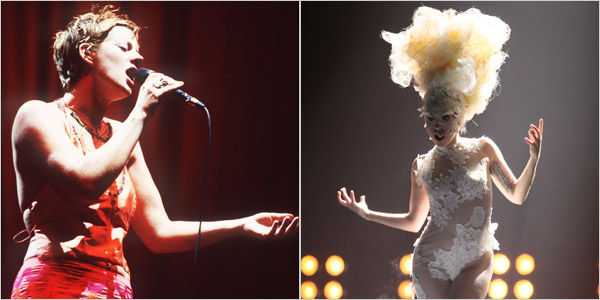 Sarah McLachlan in 1998. Her 2010 Lilith Fair tour has had to cancel dates. Lady Gaga, whose influence is pervasive among many female pop singers. By JON CARAMANICA Mario Anzuoni/ReutersKaty Perry at the same show.
Like Lady Gaga, Ms. Aguilera is willing to be molded, but in the case of the wildly uneven “Bionic” she may have found her limits, dulling both her and her more thoughtful collaborators. The album quickly faded, and Ms. Aguilera canceled her summer tour, citing other priorities. Part of the problem may have been that beneath her distressed mask is a true vocal talent that she has a difficult time suppressing. Kesha, though, has no such obstacle. Like Lady Gaga she expresses herself wholly through her exterior. But if the very abrupt rise of Kesha — whose first album, “Animal” (Kemosabe/RCA), had its debut at No. 1 on the Billboard album chart in January — has proven anything, it’s that performance doesn’t always equate with art. In her most adventurous moments Kesha has looked as if she were dressed for a “Saturday Night Live” parody of Lady Gaga. Her secondhand quirk doesn’t work. Perhaps the most Lady Gaga-like of all contemporary artists is one who has almost nothing in common with her musically. Unlike Lady Gaga, the rapper Nicki Minaj doesn’t shy away from sweat in her lyrics. She’s not aiming for abstraction or distance. Her image, though, is another thing, endlessly pliable, a site for bizarre experimentation. (She also appears on Ms. Aguilera’s new album, but can’t save it.) There’s not a hair color, outfit, shoe or makeup color she won’t try. Rarely has a woman in pop — and certainly in rap — been so aggressive about constantly revamping her appearance. What’s more, she repeatedly alters her vocal delivery, rightly understanding that while the words that come out of her mouth have meaning, they’re also sounds to be played with. It’s a spectacular thing to hear. If Lady Gaga has had direct impact on anyone, it’s been, most surprisingly, Beyoncé, who has spent the majority of her career impervious to influence from her peers. Yet in the last year, in the wake of a pair of collaborations with Lady Gaga — “Telephone” and “Video Phone” — she appears to have come alive. The videos for those songs showed her to be far more humorous than ever before. Andher most recent video, “Why Don’t You Love Me,” in which she portrays several versions of a dissatisfied midcentury housewife, is one of her best, and one of her most vivid. It’s as if Lady Gaga swooped in and infected Beyoncé with a bug, a vampiric chain of events. But has Lady Gaga been giving too much style away? “Alejandro,” her current single, initially appears to be one of her least ambitious. Its lyrics are especially vague; its Madonna borrowings are multitudinous. There is expected excess in the video, but what’s most notable are the moments between the extremes. At times the singer, almost never seen without an outfit that suggests the creation of a mad inventor, appears only in flesh-tone bra and panties, platinum-blond bangs, red lips and porcelain skin. On her, the simplicity is radical. It was also revisited on the cover of Rolling Stone last month, where she posed in a bra with machine guns attached to it — similar to one she wears in one part of the “Alejandro” video — brandishing them at some invisible enemy. It’s provocative, but for Lady Gaga, perhaps a mite too ideological. Really, the only person Lady Gaga is at war with is herself. The guns aren’t what’s important, though. Mostly what you see is skin. It’s not a salacious display, but it is a significant one. In the Rolling Stone article, speaking about stripping down in the “Alejandro” video, Lady Gaga said, “It’s just me, and people will see that what’s underneath everything is still me.” It’s probably the first time Lady Gaga has acknowledged that there’s a living, breathing organism beneath the hyperstylized exterior, that her flesh has any instincts of its own. Maybe she’s expended so much time and energy building up her outer shells that they’ve begun to reinforce her inner self too. This nakedness, this new assuredness — a Lilith ideal, perhaps — is a real step toward feeling. Or maybe the skin’s just another costume.
COMMENTS
Be the first to post a comment! Post A Comment:

|

|



.jpg)