.gif)
.jpg)
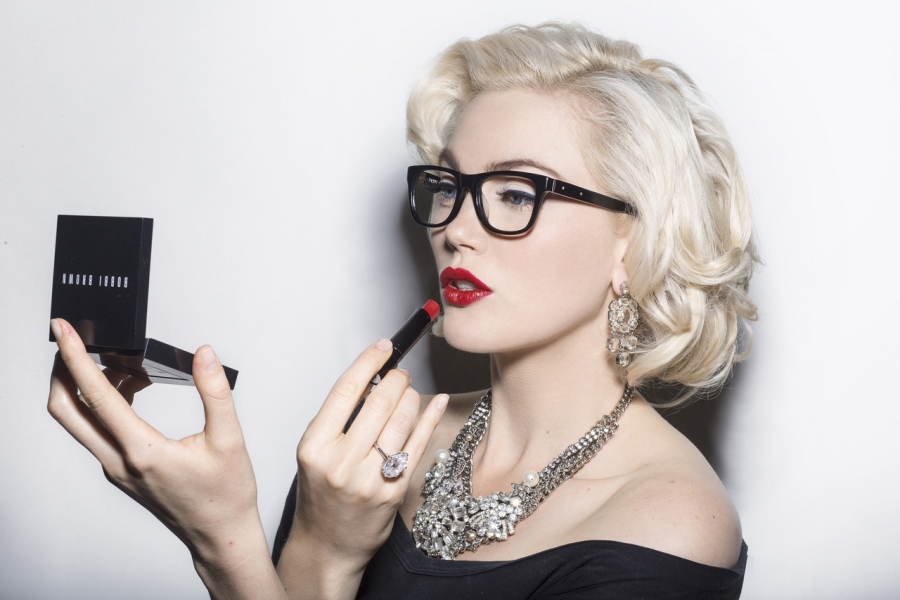
The artist Cindy Sherman, who uses herself as a model for her intense tableaus, has recently become proficient at Photoshop. “I actually love it,” she said. “Instead of doing real makeup for the shoot, I’m adding it digitally. Of course, I’m adding wrinkles while most people are taking them away.”



 
Me, Myself and iPhone
Posted on: 07/22/10

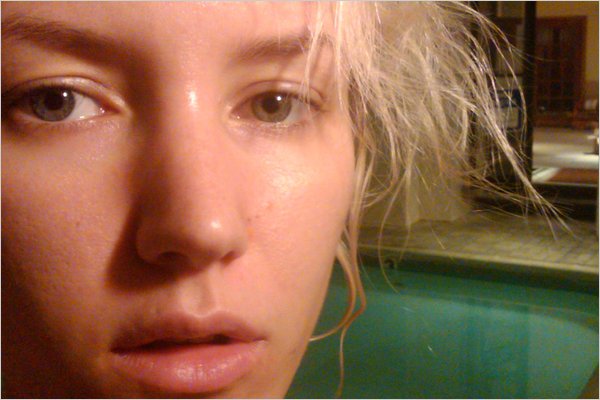 The photographer Rachel Chandler demonstrates self-shooting basics. More Photos » By DAVID COLMAN The practice is so common that it is changing photography itself. “We understood we needed to make it easier to use, in terms of image retouching and manipulation,” said Bryan O’Neil Hughes, the product manager for Photoshop. “Everybody is suddenly representing themselves to the world this way, and you see people doing different things, just to make themselves look better or stand out — anything from mild retouching to putting themselves in pictures and making themselves look like paintings, and all that ‘Avatar’-y sort of stuff.” Ms. Sherman does share one characteristic with the self-shooting masses: She feels far less comfortable as a subject when she is not the photographer. “I’m still very self-conscious when someone takes my portrait,” she said. “A lot of pictures, I just cringe when I see them.” With yourself as the photographer, though, self-consciousness fades fast, as Mr. Gould of Daily Mugshot noticed when he began capturing himself daily for his own program. “When I started doing it, I was pretty self-conscious,” he said. “You want to make sure you look good and the lighting’s good. But as it becomes part of your life, you just embrace your crazy hair. Or you notice that you’re still wearing the same shirt from yesterday and you don’t care.” Basically, he said, what starts off as an exercise in narcissism and image control eventually devolves into something more routine and candid, a chronicle of the same face we present to the world, despite our best efforts at airbrushing our flaws. As mundane as that sounds, one of the findings of the OkCupid research was that people respond more favorably to straightforward photos that clearly are taken by the subjects themselves — with, say, the telltale curve of the arm snaking up the side of the picture — than to pictures that are better composed and show them in a more flattering light. Sam Gosling, an associate professor of psychology at the University of Texas at Austin and the author of “Snoop: What Your Stuff Says About You,” has done studies on the assumptions people make about strangers in photographs. He reasons that people are drawn to candid snapshots because they seem more trustworthy than a lovely picture that may not be a faithful rendition. “What we’ve found is that this stuff is harder to manipulate than you think,” he said. “We’ve done studies with Facebook where we take down people’s impressions of someone’s Facebook photos, then compared those impressions to how that person wants to be seen, and how they actually see themselves.” The result: They see you as you see yourself, not as you want to be seen The camera doesn’t lie, after all — not when it really gets to know you. COMMENTS
Be the first to post a comment! Post A Comment:

|

|

.jpg)